
State Awards $25 Million to Cotton Belt Trail
Funding to help improve multimodal connectivity along DART’s new Silver Line
FOR IMMEDIATE RELEASE
Contact: Brian Wilson
(Arlington, TEXAS) – A bicycle-pedestrian trail being built alongside the recently opened Silver Line is moving closer to completion after receiving a financial boost from the state. The Texas Transportation Commission recently awarded Dallas Area Rapid Transit (DART) $25 million for construction of Phase 3A of the Cotton Belt Trail as part of a statewide effort to improve active transportation infrastructure through the Transportation Alternatives Set-Aside Program.
The Cotton Belt Trail has long been envisioned as a key east-to-west connector in North Texas’ expanding regional trail network. Spanning 26 miles from Plano to Dallas Fort Worth International Airport, the trail will follow DART’s new Silver Line commuter rail and is designed to give users a continuous, safe option for walking and biking across multiple cities.
DART is overseeing the trail construction, including 11 miles in Phase 2 currently under construction from western Addison to the Shiloh Road Station in Plano. The $25 million awarded to construct Phase 3A of the Cotton Belt Trail will help provide walking and bicycling access directly to the Cypress Waters (Dallas), Addison and Downtown Carrollton stations, three of the 10 stops along the DART Silver Line, which began serving passengers in October. Phase 3A Trail construction is anticipated to begin by mid-2027.
“We are deeply appreciative to the Texas Department of Transportation and the Texas Transportation Commission for supporting the Cotton Belt Trail and other initiatives that help expand multimodal travel in our region,” said Kevin Kokes, a program manager for the North Central Texas Council of Governments’ Land Use and Mobility Options team. “By improving connections to employment, housing, education facilities, and recreational opportunities, these projects help build a stronger, more accessible future for everyone.”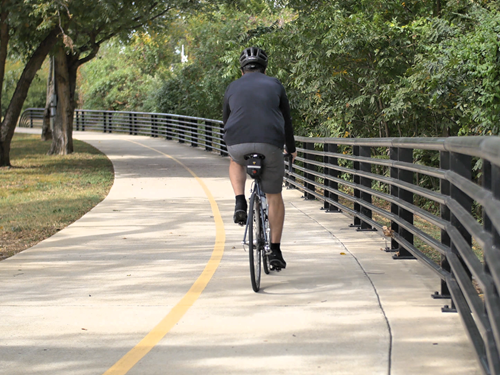
Running along the former St. Louis Southwestern Railway corridor, known by its nickname of “The Cotton Belt Route,” the trail preserves the legacy of the Cotton Belt Line, a route that operated for decades from Texas to St. Louis, Missouri.
The trail represents one part of a broader, long-term transportation vision led by NCTCOG to connect cities in the Dallas-Fort Worth region through an integrated network of shared-use paths. Other major efforts include the DFW Discovery Trail, a developing 60-mile corridor linking Fort Worth, Arlington, Grand Prairie, Irving and Dallas. These ongoing projects reflect a coordinated strategy to provide North Texas residents and visitors with more options to travel safely by foot or bike, while also improving regional mobility and quality of life.
In addition to the Cotton Belt Trail Phase 3A, the Commission awarded almost $30 million to six other projects across the Dallas-Fort Worth metropolitan area as part of a $285 million infusion for bicycle and pedestrian transportation projects across Texas.
Transportation Alternatives Set-Aside Program Awards in DFW
Project | Agency | Funding Award |
Cotton Belt Trail (Phase 3A) | DART | $25 million |
Trinity Forest Spine Trail – Bike/Ped Bridge | City of Dallas | $10.9 million |
Midtown Dallas Shared Use Trail | Midtown Dallas Inc. | $10.5 million |
Southeast Trail (Phase 1A) | City of Balch Springs | $6.4 million |
Park Row Drive Pedestrian Improvements | City of Pantego | $791,200 |
King's Gate and Meadow Place Bike Lanes | City of Willow Park | $552,800 |
City of Azle Active Transportation Plan | City of Azle | $440,000 |
About the Regional Transportation Council:
The Regional Transportation Council (RTC) of the North Central Texas Council of Governments has served as the Metropolitan Planning Organization (MPO) for regional transportation planning in the Dallas-Fort Worth area since 1974. The MPO works in cooperation with the region’s transportation providers to address the complex transportation needs of the rapidly growing metropolitan area. The Dallas-Fort Worth metropolitan area includes Collin, Dallas, Denton, Ellis, Hood, Hunt, Johnson, Kaufman, Parker, Rockwall, Tarrant and Wise counties. The RTC’s 45 members include local elected or appointed officials from the metropolitan area and representatives from each of the area’s transportation providers. More information can be found at www.nctcog.org.
###