
Legislative Affairs
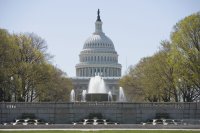 Both the Texas Legislature and the United States Congress address many important transportation issues that affect the Dallas-Fort Worth area.
Transportation and air quality in the North Central Texas region are impacted by legislative decisions at the State and federal levels.
NCTCOG staff regularly update policy and technical committee members, transportation partners and others interested in monitoring legislative initiatives related to the Regional Transportation Council (RTC) legislative priorities.
In order to understand current legislative initiatives, the RTC directed the development of a Transportation Funding 101 primer so legislators and the general public can better understand funding sources for transportation as well as trends that impact the amount of funding available. A shortfall of funding has been identified and the primer also addresses potential solutions to increase funding options.
September 4, 2026
FROM WASHINGTON, D.C.
On September 1, the U.S. House of Representatives passed the Continuing Appropriations and Extensions Act, 2027 (HR 6500), by a vote of 370-48. The bill is both a Continuing Resolution (CR) that funds the federal government, including FTA, FRA, and USDOT programs, and a short-term Surface Transportation Authorization extension through December 11. Prior to House consideration, the Senate passed the bill on August 8 by a vote of 90-6. President Trump signed the CR into Law on September 2.
The passage of HR 6500 prevents a federal government shutdown on October 1 and continues Highway Trust Fund (HTF) programs and annually appropriated general fund programs at prorated Fiscal Year (FY) 2026 levels through December 11. However, that CR does not provide funding for the Division J advance appropriations programs contained within the Infrastructure Investment and Jobs Act (IIJA), which provided $36.8 billion per year over five years. Due to this exclusion, no new FY 2027 funding would be available on October 1 for key transportation programs such as Safe Streets for All (SS4A) grant, Federal-State Partnership (FSP) for Intercity Passenger Rail grant program, Bridge Investment Program (BIP), National Electric Vehicle Infrastructure (NEVI) formula program, and Consolidated Rail Infrastructure and Safety Improvement (CRISI) grant.
Additionally, HR 6500 includes a provision precluding the White House Office of Management and Budget (OMB) from finalizing its proposed Uniform Guidance rule (2 CFR 200) through at least December 11. In May 2026, the OMB proposed a comprehensive rule to revise 2 CFR 200, the federal regulations that govern how hundreds of billions of dollars in federal grants are awarded, managed, and audited across research universities, healthcare systems, state/local governments, and non-profits.
Even with one or more short-term extensions, Congress will still need to draft a full surface transportation bill to continue vital transportation programs. The main focus in both chambers remains the November 2026 elections, which are less than 90 days away.
US Congress Monitored Bills - For more information, contact Jackie Nolasco
FROM AUSTIN
The Senate Finance Committee met on July 27 to discuss interim chargers related to Evaluating Transportation Resources and Data Center Investment and State Fiscal Effects. For Transportation Resources, the Committee was charged to study current transportation funding from all sources and the long-term needs of Texas drivers, to assess the implementation of funding appropriated by the 89th Legislature, and to make recommendations to ensure the effective and efficient use of transportation funding. The Legislative Budget Board (LBB) and the Texas Department of Transportation (TxDOT) were invited to provide witness testimony. Senators asked questions related to the Road Grade Separation grant program, farm to market roads, MPO-prioritized projects, managed lanes, and Municipal Utility Districts (MUDs).
The House Transportation Committee met on August 17 to discuss interim charges related to monitoring the implementation of the railroad grade separation grant program, legislative prioritization of TxDOT, TxDOT’s construction communications, speed enforcement in work and school zones, Texas Department of Motor Vehicles (TxDMV) review, and agency oversight for TxDMV, TxDOT, and the Texas Transportation Commission (TTC). Committee Chair Tom Craddick (TX-82) reintroduced the concept of a fund for legislators to direct funds to their districts, citing similar initiatives in other states. Additionally, the Chair and members expressed their dissatisfaction with TxDOT's funding allocations and public involvement practices, emphasizing the need for legislator-directed allocations. Finally, the Committee heard testimony on technology used in Arkansas to assist workers in work zones. These devices, unlike Flock and red-light cameras, allow police officers to monitor work zones from a distance and intervene as needed.
June Texas Transportation Committee Hearing
The TTC met on June 24. Routine information was presented for their approval, including highway improvements, transportation facilities, routine maintenance, and construction and rehabilitation of buildings. The Commission heard presentations on TxDOT’s FY 2028-2029 Legislative Appropriations Request (LAR) and the Unified Transportation Program (UTP). Additionally, the Commission approved awarding a total of $107,966,561 in state and Federal Transit Administration (FTA) program funds to support a variety of public transportation needs in rural and urban areas of the state, including Arlington, Grand Prairie, Mesquite, and McKinney-Frisco.
July Texas Transportation Committee (TTC) Hearing
The TTC met on July 30. Routine information was presented for their approval, including highway improvements, routine maintenance, and construction and rehabilitation of buildings. Additionally, the Commission heard presentations on TxDOT’s FY 2028-2029 Legislative Appropriations Request (LAR), which included funds for the Amtrak Heartland Flyer.
Upcoming Committee Hearings
TEXAS SENATE
- The Senate Transportation Committee will meet on Tuesday, August 25, at 9 am. The Committee will discuss the following interim charges of interest:
- Prioritizing Public Safety at Rail-Grade Crossings: Examine the Texas Department of Transportation’s implementation of increased funding for rail-grade separation projects. Examine how the agency is using these new resources to prioritize projects for mobility and safety concerns. Make recommendations to ensure that expanded state investments deliver measurable improvements in freight movement and community safety.
o Studying the Deployment of Autonomous Vehicle Technology: Study the deployment of autonomous vehicle technology as authorized by SB 2807, (89th Session), including rulemaking adopted by the Texas Department of Public Safety, the Texas Department of Motor Vehicles and the Texas Department of Licensing and Regulation. Quantify the impact on traffic-related collisions. Make recommendations to ensure that the continued deployment of autonomous vehicles prioritizes public safety and aligns with the evolving technological landscape on Texas roads.
- Prioritizing Public Safety at Rail-Grade Crossings: Examine the Texas Department of Transportation’s implementation of increased funding for rail-grade separation projects. Examine how the agency is using these new resources to prioritize projects for mobility and safety concerns. Make recommendations to ensure that expanded state investments deliver measurable improvements in freight movement and community safety.
- The Senate Economic Development Committee will meet on Thursday, September 3, at 9 am. The Committee will discuss the following interim charge of interest:
- Ensuring Local Hotel Occupancy Tax Accountability: Study the collection, reporting, and use of state and local hotel occupancy tax revenues, and review data and outcomes under the current legislative framework to assess whether it is operating as intended. Make recommendations to ensure the effectiveness of local incentives and safeguard long-term fiscal accountability.
TEXAS HOUSE
- The House Transportation Funding Subcommittee will meet on Wednesday, September 2, at 10 am. The Subcommittee will meet to hear invited testimony only on the following interim charge:
- Texas Department of Transportation Funding: Examine the formula funding and discretionary funding categories used by the Texas Department of Transportation to allocate dollars for planning and construction of projects. Examine the adequacy of current funding revenue to meet projected transportation needs. Evaluate continuing the County Transportation Infrastructure Fund grant program and assess its benefits to rural road infrastructure and public safety. Recommend ways to improve transportation-related funding, allocation methodologies, and transparency.
Recent Committee Hearings
TEXAS SENATE
- The Senate Finance Committee met on Monday, July 27, at 10:30am. The Committee discussed the following interim charges of interest:
- Evaluating Transportation Resources: Study current transportation funding from all sources and the long-term needs of Texas drivers. Assess the implementation of funding appropriated by the 89th Legislature and make recommendations to ensure the effective and efficient use of transportation funding.
- Data Center Investment and State Fiscal Effects: Since the passage of House Bill 1223, 83rd Legislature, in 2013, the state cost of providing a sales tax exemption to qualifying data centers has grown from an estimated $14.6 million for the 2014-15 biennium to a projected $3.3 billion for the 2028-29 biennium. Study the cost and consequences of the sales tax exemption provided to data centers under Tax Code Sections 151.359 and 151.3595. Make recommendations providing safeguards to ensure that Texans benefit from data center investment.
TEXAS HOUSE
- The House Land and Resource Management Committee met on Monday, July 20, at 9am. The Committee discussed the implementation of the following bills:
- HB 24: relating to procedures for changes to a zoning regulation or district boundary
- SB 15: relating to size and density requirements for residential lots in certain municipalities
- SB 840: relating to certain municipal regulation of certain mixed-use and multifamily residential development projects and conversion of certain commercial buildings to mixed-use and multifamily residential occupancy; and
- SB 1567: relating to the authority of home-rule municipalities to regulate the occupancy of dwelling units.
- The House General Aviation Select Committee met on Tuesday, August 18, at 10am. The Committee discussed following interim charges:
- Examine the condition and capacity of general aviation airports in the state, as well as capital improvements necessary to promote transportation access and aviation safety. Identify opportunities for the state to maximize federal funding for airport improvements and other alternative funding sources for aviation infrastructure.
- Evaluate barriers for carriers to expand regional air service and enter underserved markets. Recommend options for the development of a statewide regional air service master plan.
- Study shortages in the aviation workforce and explore opportunities for the aviation industry to partner with public universities, community colleges, and state technical colleges to develop training pathways.
- Examine the role of general aviation airports in responding to disasters. Identify improvements to better facilitate staging and deployment of assets, and improved coordination between state and federal agencies.
- Study governance and procurement frameworks for general aviation airports, including the assessment of fees. Recommend best practices to improve operational efficiency and position general aviation airports to integrate emerging aviation technology.
- The House Telecommunications and Broadband Subcommittee met on Tuesday, August 18, at 11am. The Subcommittee discussed the following interim charge of interest:
- Broadband Development: Monitor the activities of the Broadband Development Office and review awards made through the Broadband Equity, Access, and Deployment Program, and the Broadband Infrastructure Fund.
US SENATE
- The Senate Commerce, Science, and Transportation Committee held a hearing on Tuesday, June 9 to discuss “The Need for Speed: How Technological Advances are Driving Transportation Innovation.”
US HOUSE
- The House Appropriations Committee held a markup hearing on Thursday, June 4 to review the FY 2027 Transportation, Housing and Urban Development, and Related Agencies Bill.
Texas Legislature - 89th Session January 14, 2025 - June 2, 2025
- Regional Transportation Council Legislative Program for the 89th Texas Legislature
- 89th Texas Legislature Summary of Bills (2025)
- 89th Texas Legislature Final Actions Presentation - Transportation
Texas Legislature - 88th Session January 10, 2023 - May 29, 2023
- Regional Transportation Council Legislative Program for the 88th Texas Legislature
- 88th Texas Legislature Summary of Bills (2023)
Other Resources
Congressional Updates important to our region
In 2005 Congress passed the Safe, Accountable, Flexible, Efficient Transportation Equity Act: A Legacy for Users (SAFETEA-LU) . This legislation guided surface transportation policy and funding through 2009. Nine short-term extensions passed since SAFETEA-LU expired in 2009. The final short-term extension of SAFETEA-LU extended surface transportation authorization through June 30, 2012.
On July 6, 2012, President Obama signed into law a two-year $105 billion surface transportation authorization, titled Moving Ahead for Progress in the 21st Century (MAP-21). MAP-21 reauthorized the federal-aid highway, highway safety and transit programs that were last authorized by SAFETEA-LU. New programs and funding levels began on October 1, 2012, and continued through September 30, 2014. The final short-term extension of MAP-21 expired on December 4, 2015.
On December 4, 2015, President Obama signed the Fixing America's Surface Transportation (FAST) Act into law, which authorizes Federal highway, transit, safety and rail programs for five years at $305 billion. The FAST Act is effective October 1, 2015 through September 30, 2020.
The Infrastructure Investment and Jobs Act (IIJA), signed into law by President Biden on November 15, 2021, is a five-year bill that authorizes $567.5 billion for surface transportation, including roads and bridges, and an additional $550 billion for water, broadband, cybersecurity, and energy infrastructure. With a total funding amount of $1.2 trillion, the act aims to modernize infrastructure across the nation and is set to expire on September 30, 2026.
2025 RTC Principles for Federal Surface Transportation Authorization